Tech, Tips, and Tutorials.
Reviews, News, and Rants.

Showing posts with label nikon. Show all posts

Nikon 16-85mm f/3.5 - 5.6 VR (rumour mill)

Hot off the rumour mill!
It's now official! See the press release (external link)


Image by: stfbfc on flickr.

Nikon appear to be poised to release a new 16-85mm lens later this month - in time for PMA. The new lens seems to be a replacement for their 18-70mm f/3.5 - 4.5.

Features

  • Adds VR mechanism: This will give roughly 3-4 stops of stabilisation.
  • Obviously, it's an AF-S lens, which means that it will focus with the D40 / D40x models.
  • Starts at 16mm. The extra kick at the wide angle compared to the 18-70 means you get a very wide 24mm equiv. FOV.
  • A bit extra reach - 85mm. Won't make much of a difference, but it makes it a nice all round 24-128mm lens for the crop bodies.
  • It's a DX format, G-series lens. This means that it will work on DX bodies (D40, D80, D300, etc), but will only work on the D3 in DX-crop mode.
  • It's a G-series lens. It has the disadvantage of not having an aperture ring. Forget working it on old manual-only film cameras. You have to set the aperture electronically via the camera.
  • Slower! This lens is a very slow f/5.6 at the long end. At least they gave it VR to compensate slightly. Making it slower means that they've been able to keep it relatively light and compact.

What it might be like

Most probably, sharpness levels will be very similar to the already excellent 18-70mm, maybe slightly better. Size and weight also appear to be similar. It will almost certainly be positioned slightly higher than the 18-55 VR kit lens. Focus speed should also be faster than the 18-70.

Pricing? Release date?

I haven't really heard anything reliable on pricing, but it appears that it will be around $300 / €300. Release date will probably be just before PMA, later this month.

UPDATE (3rd Feb 08)
Still no word on an official release date, however we do at least have some word on pricing. The RRP appears to be at £429.99 / €642.00 (roughly $850 - $950)

References

Continue Reading

Nikon digital SLR family

Last Updated: 17 Jan 08 (v2)

Nikon have a total of 6 digital SLRs in production today.


Consumer


  • Nikon D40
    6 MP DX sensor (announced November 2006)

    Nikon's lowest-end digital SLR. Aimed at either the absolute beginner; those moving up from a point-and-shoot; or those looking for a low-cost gateway to the Nikon system. Famous for: price and image quality. Infamous for: supporting auto focus only on AF-S/AF-I lenses. Having 'only' 6 megapixels. The Nikon D40 replaced the Nikon D50.

  • Nikon D40x
    10 MP DX sensor (announced March 2007)

    A 'big-brother' to the Nikon D40. The biggest difference is that this has 10 megapixels (4 more over the D40). It is primarily intended to provide competition to the Canon EOS 400D in the crowded 10 MP entry-level market. Famous for: Having the same image quality as the excellent D40. Infamous for: auto focus with AF-S/AF-I lenses only. The Nikon D40x has no predecessor. It doesn't replace the Nikon D40 or D50.

  • Nikon D80
    10 MP DX sensor (announced August 2006)

    Nikon's feature-full intermediate camera. Priced above the D40/x line and offers more features, including autofocus with older AF lenses. Famous for: Image quality, features. Infamous for: Often flawed Matrix Metering. The Nikon D80 replaces the Nikon D70s.


    Professional


  • Nikon D200
    10 MP DX sensor (announced November 2005)

    Offering a robust magnesium body and superb ergonomics in a compact body, the Nikon D200 is a camera mainly aimed at professionals looking for a backup body, and amateurs/enthusiasts looking for premium performance. Famous for: build quality, features, performance. Infamous for: Noisy high ISO. The Nikon D200 was a huge upgrade over the aged Nikon D100. Note: the new D300 has NOT replaced the D200. D200's are still being produced today.

  • Nikon D300
    12 MP DX sensor (announced August 2007)

    The Nikon D300 is a semi-professional camera. It has a lot in common with the much larger, professional level D3. Its main features are: a weather-sealed magnesium body; 6 fps (expandable to 8 fps with battery grip); 14-bit image processing (shared with D3); professional 51-point AF (shared with D3); 922k-pixel 3" LCD screen (shared with D3); Live View with Contrast-Detect AF (shared with D3); and a dust shaker. Famous for: professional features, value for money. Infamous for: Some early adopters are reporting faulty metering, these were replaced under warranty. The Nikon D300 doesn't replace the D200 according to Nikon literature.


  • Nikon D3
    12 MP FX sensor (announced August 2007)

    The Nikon D3 is a professional camera. It offers plenty of professional-level features and many firsts for Nikon. Most notably, it is the first Nikon to have a full-frame 35mm sensor (coined FX-format). It offers: an unprecedented 9 fps; 51-point advanced AF system; 14-bit image processing; 5.1 MP DX crop mode; 922k-pixel 3" LCD screen; Live View with Contrast-Detect AF; and a robust, fully weather-sealed body. Famous for: FX format sensor, image quality sets new standards. Infamous for: Nothing, except that the high price tag puts it out of the reach of many. The Nikon D3 seems to have replaced the D2Hs. But because it has no 'H' suffix, it is suggested that it also replaced the D2Xs. However, rumours of a high-resolution D3X have been circulating for months.

  • Continue Reading

    Why I didn't go for the Nikon D40x

    No image? Click here to attempt opening it in a new window The Nikon D40x was a camera that was released four months after the original D40. It was built so that those that felt that they need more than 6 MP will have the camera they want. It is priced to be in direct competition with Canon's EOS 400D. It wasn't intended to be a replacement model, just a “big brother” version of the D40.
    Note: This isn't an article written to justify my purchase. Read the post's title. It's an article about why I didn't buy the D40x instead.

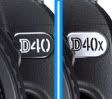
    Besides a few internal differences, the D40x is identical to the D40. It uses the exact same body, the same screen, the same menus and interface, and all the things which made the D40 such a great camera. In fact the only external difference is the badge.

    Below are the most significant differences between the two: - 10 megapixel CCD sensor (D40 has 6 MP)
    - 3fps (D40 shoots at 2.5fps)
    - Lowest ISO of 100 (D40's lowest is ISO 200)
    - Lm100 (€235 or £160) more expensive
    - Flash x-sync: The D40 is one of the few dSLRs that can sync the flash right up to 1/500. The D40x, D80 and higher can only sync up to 1/200.
    - Slightly noisier shutter. Above 1/100 the D40 uses a silent electronic shutter, while the D40x uses a mechanical shutter right till 1/4000. This is the reason for the D40's higher x-sync speed.

    One of the reasons that I like the Nikon D40 is because it has a relatively low pixel count. More megapixels mean worse image quality, given the same sensor size and tech. Anyway, 4 more MP isn't that big a deal. While 10 MP sounds like almost double 6 MP, in fact it isn't. It is only a 22% increase. In order to double the resolution of 6 MP, you would need a 24 MP camera.

    Having more MP is a good idea if you plan on making huge prints and viewing them with your nose touching the print. 6 MP is more than enough to print beautifully up to A3 size, and even A2 with some work. Who prints that big anyway? Not the average D40(x) user anyway.

    Shooting at 3 fps compared to 2.5 fps is a non-issue. 0.5fps will not make a big difference. Get yourself a 9/11fps Nikon D3 if you're serious about continuous shooting(RRP Lm5,000).

    Going down to ISO 100 would have been very important if it was a compact camera (they suck at anything above ISO 100), but the D40's ISO performance is so good, you won't miss ISO 100.

    All in all, the D40x just wasn't worth the Lm100 premium for me.

    Continue Reading

    Nikon D40: Overview

    No image? Try clicking here

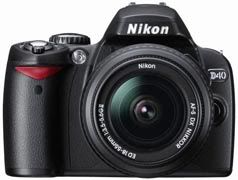
    The Nikon D40 is an entry-level digital SLR camera. It replaces the Nikon D50. It was announced in November 2006, after lots of speculation and leaks.

    Click here to read an in-depth review of the Nikon D40

    Who should buy a Nikon D40?

    The D40 is a camera primarily aimed towards beginners. It can "teach" its users about the innards of photography through interactive learning. Here's an excerpt from an article in Time magazine by Wilson Rothman:

    The D40 is a teacher. One of its most fascinating attributes is the Info screen, which appears at the touch of a button, appropriately marked "Info." The screen contains all sorts of data, mostly photographic mumbo jumbo. But the screen also has a visual representation of that mumbo jumbo, so you can figure out what it means. For instance, as the number next to the letter "F" goes up, the image of the camera's aperture gets tighter. It doesn't take long to sort out, then, that the higher the "f-stop," the more closed the camera's aperture. Beginners will appreciate the fact that the D40 has a knob of preset modes, not just my favourite "auto" mode but "portrait," "sports" and more. What's cool is that, when you change modes, the screen shows the changed settings. Little by little, the notions will start to sink in: what the camera is trying to do to shoot action, what it needs to take a portrait at night, etc.

    However, the D40 is versatile enough to serve more than just a beginner. If you're an amateur photographer on a budget, you'll find the D40's price extremely tempting.

    Don't think that the D40's "idiot" modes will get in the way, they don't. If you're already experienced enough to know the basics, then you'll be able to shoot in the more advanced P, A, S, M modes. While this camera is designed for beginners, it doesn't get in the way of the more advanced photographers.

    The D40 offers an incredible amount of camera for the money, and every penny seems well spent. Every now and then it makes the more expensive Nikon D80 look over-priced and under-powered.

    AF issue with Older Lenses

    The D40 will not be able to autofocus with lenses that don't have an in-built focus motor. Reason being that, it doesn't have its own “screwdrive” focus motor. A lot of older and third party lenses rely on the motor in the body to focus. Hence, they will not be able to AF on the D40. The only ones that are able to autofocus are Nikon's AF-S/AF-I type lenses, and Sigma's HSM type lenses.

    If you plan to use the autofocus feature of older lenses, then the D40 is not the camera for you. The newer lenses should all work perfectly however.

    Competition

    - Canon EOS 400D
    - Pentax K100D / K110D
    - Olympus E-410

    Main Features

    - 6 megapixel DX format CCD sensor (same used in Nikon D70 & D50, Pentax K100D)
    - Multi-CAM530 3-Area AF sensor
    - 3D Colour Matrix Metering II (420 pixel sensor) – for accurate exposures
    - ISO range from 200 to 1600, plus boost to HI-1 (approx. 3200)
    - Customisable Auto ISO
    - Up to 2.5 frames per second continuous shooting. Buffer: unlimited amount of JPEGs
    - 2.5", 230k pixel LCD monitor with high viewing angle
    - Monitor-based status screen – called the "Info" screen
    - In-camera Help Manual
    - In-camera Retouching Menu
    - Extensive list of Custom Functions, unusual in this price range
    - 0.8x magnification, 95% coverage viewfinder view
    - Small and compact, lightweight body
    - Value for money

    Reviews

    The Nikon D40 is a very popular camera, and has been reviewed by almost every major review station. Below are some links to the pick of the reviews..

    Click here to read an in-depth review of the Nikon D40

  • dpreview's Review (by Phil Askey). Probably the best review here. Technical, yet easy to understand. Extremely useful.
  • DC Resource's Review (by Jeff Keller). A nice conversational tone makes this one easy and enjoyable to read. Very informative.
  • Imaging Resource's Review (by Mike Pasini). A very exhaustive review. Goes into extreme technical detail. Supplied with loads of samples and a test gallery.
  • Review by Thom Hogan. Nikon expert Thom Hogan answers some technical user questions, and also provides thoroughly subjective observations on the camera.
  • Review by Ken Rockwell. Ken Rockwell's "opinionated, cranky style" is evident here. In this review, he avoids many technical aspects, in the sake of a simplistic review - but also makes some valid points about why he loves this camera so much.

  • Continue Reading

    Nikon D40 Review (Part 1 of 6)

    No image? Try clicking here

    A detailed real-world review of the Nikon D40 along with the 18-55mm f/3.5-5.6 kit lens.

    Skip to:
    << Previous Next >>


    Preamble

    The Nikon D40 is a very popular camera, with every major review site out there covering it. With good reason. It's Nikon's smallest and cheapest digital SLR ever. This meant opening up a whole new customer segment to the world of digital SLRs, and more importantly, an affordable gateway into the Nikon system.

    This is not meant to be a comprehensive, scientifically accurate user review, I'll leave that to the experts. The real purpose of this is to report my first impressions, both as a first-time DSLR user, and also as a photographer. I'll be making several comparisons to the Canon EOS 400D (Digital Rebel Xti).


    AF issue with Older Lenses

    The D40 will not be able to autofocus with lenses that don't have an in-built focus motor. Reason being that, it doesn't have its own “screwdrive” focus motor. A lot of older and third party lenses rely on the motor in the body to focus. Hence, they will not be able to AF on the D40. The only ones that are able to autofocus are Nikon's AF-S/AF-I type lenses, and Sigma's HSM type lenses.

    If you plan to use the autofocus feature of older lenses, then the D40 is not the camera for you. The newer lenses should all work perfectly however.

    Continue Reading